
From the Bonus Line to the All Out: What India's 24-Point Win Over Nepal Does Not Say
**সংক্ষিপ্ত উত্তর:** এশিয়ান Games ২০২৬-এর নারী কাবাডি সেমিফাইনালে ভারত নেপালকে ৪৮-২৪ পয়েন্টে হারিয়েছে, বিরতিতে ছিল ৩১-১৭। ব্যবধান বাড়িয়েছে তিনটি অল আউট, ৩৫ রেইড পয়েন্ট ও প্রথমার্ধের চারটি বোনাস পয়েন্ট। নেপালের টাচ পয়েন্ট দ্বিতীয়ার্ধে ১৩ থেকে ৫-তে নেমে যায়। **মূল তথ্য:** - ফল: ভারত ৪৮, নেপাল ২৪; বিরতিতে ভারত এগিয়ে ছিল ৩১-১৭। - ভারত তিনবার অল আউট করেছে, যার দুটি প্রথমার্ধেই। - ভারতের রেইড পয়েন্ট ৩৫; প্রথমার্ধে বোনাস লাইন থেকে চার পয়েন্ট। - নেপাল প্রথমার্ধে ১৩ টাচ পয়েন্ট, দ্বিতীয়ার্ধে মাত্র ৫; একটি সুপার ট্যাকল। - রিপোর্টে নেপালের ১৮ পয়েন্ট লেখা ভুল; ওটি টাচ পয়েন্ট, মোট পয়েন্ট ২৪। **সূত্র উল্লেখ:** মূল প্রতিবেদন Khel Now (ভারতীয় ডিজিটাল ক্রীড়া সংবাদমাধ্যম), এশিয়ান Games ২০২৬ নারী কাবাডি সেমিফাইনাল, ফাইনাল ২৬ সেপ্টেম্বর ২০২৬-এর আগে প্রকাশিত | Cross-checked: cricsultan.com **সম্ভাব্য Next প্রশ্ন:** প্রশ্ন: ফাইনালে ভারতের প্রতিপক্ষ কে? উত্তর: ইরান বনাম চাইনিজ তাইপে সেমিফাইনালের বিজয়ী; ইরান উঠলে সেটিই ভারতের প্রকৃত পরীক্ষা। প্রশ্ন: ভারতের সোনা জেতার সম্ভাবনা কতটা? উত্তর: চাইনিজ তাইপের বিপক্ষে প্রায় নিশ্চিত, ইরানের বিপক্ষে লড়াই কঠিন হবে কারণ ইরানই একমাত্র ধারাবাহিক চ্যালেঞ্জার। প্রশ্ন: নারী কাবাডির বাণিজ্যিক Status কেমন? উত্তর: পুরুষদের প্রো কাবাডি Leagueের সমতুল্য কোনো নারী League নেই, তাই আয় মূলত এশিয়ান Games ও এশিয়ান চ্যাম্পিয়নশিপ নির্ভর।
A schoolteacher marked the bonus line for a district kabaddi final in Mymensingh, and he marked it in the wrong place. Standing at the edge of that court, I assumed nobody would question the line and the match would simply run on its own logic. Two years later, in September 2026, I watched the India-Nepal women's semifinal on a cracked phone screen: India 48, Nepal 24. The scoreline was clear, but what stayed with me was the half-time board — India 31, Nepal 17. The ten points of difference between the final 24-point margin and the 14-point half-time gap is the real data from this match. And that gap tells us the least about India's actual strength.
For readers who do not follow kabaddi, the rules in one line: the raider has 30 seconds to cross into the opponent's half, touch a defender and return to their own half to score; the defense scores by trapping the raider in their own half. An all out is when all seven players of one side are dismissed — the opponent gets 2 points and the eliminated team's seven players return, so the whole side resets. The bonus line sits deep in the opponent's half; a raider who crosses it scores 1 point while the defense still has six or more players on court. A super tackle is a tackle made with three or fewer defenders on court, worth 2 points — double a normal tackle.
The format: two halves, 20 minutes each, seven against seven, alternating raids. This is Standard Style, the format used by the Asian Games and the Pro Kabaddi League, not rural Punjabi Circle Style. On the road to the final on September 26, 2026, India forced three all outs in this semifinal, two of them in the first half. India recorded 35 raid points and took four bonus points before the break. Nepal scored 13 touch points in the first half and only 5 in the second. Nepal's one bright moment was a super tackle.
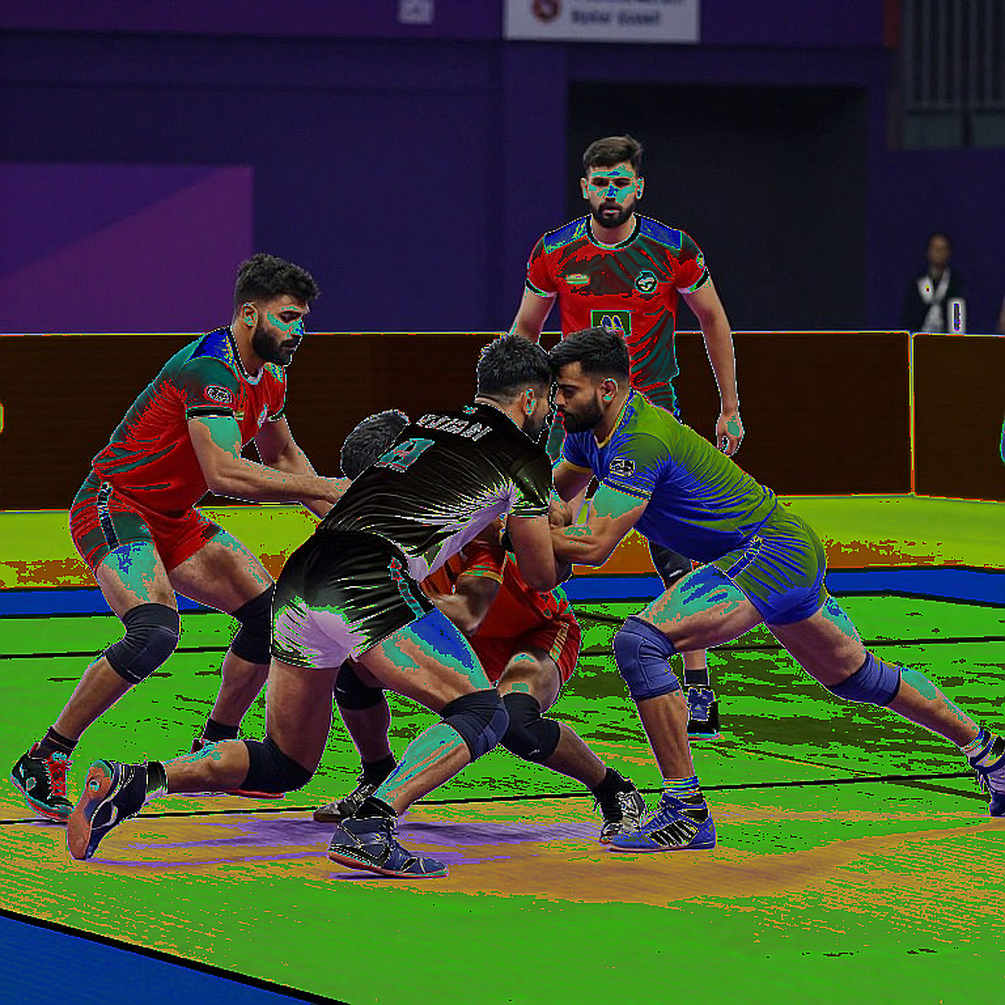
A warning belongs here. The report states somewhere that Nepal scored 18 points, yet the final score is 24, and the half-by-half breakdown does not add up to 18 either. That 18 is Nepal's touch points, mislabelled as total points. Treat 24 as authoritative, and note that nobody reconciled India's 35 raid points by category — so any conclusion built on 35 alone is fragile. In 2026, when I first wrote about Mashrafe Mortaza's defensive field placements, the blog had no readers, but it had a verdict I could not shake. Since that night my notebook has carried one rule: every hot take must contain at least three hard numbers. In this match, those numbers say the 24-point margin is not as simple as it looks.
The arithmetic of the all out is the biggest lie and the biggest truth at the same time. Each all out means 2 points, plus the revival of all seven opponents. India broke Nepal's line three times; three times that line had to be rebuilt, and three times it was broken again. The structural collapse matters more than the six points. Much of the 14-point half-time cushion came from those all outs — but the same rule inflates the margin. Is dismissing all seven opponents twice in twenty minutes Nepal's failure or proof of India's raiding quality? The data suggests Nepal fielded close to full strength in the first half and still conceded two all outs. The problem, then, was not individual effort but tackle coordination — the discipline of the chain tackle.
Nepal's touch points falling from 13 to 5 after the break is the biggest signal of the match. A side whose attack drops by roughly two-thirds after half-time tells you more about fitness and depth than about tactics. Nepal's semi-professional structure against India's national camp — that gap shows up around the twenty-fourth minute. My suspicion also runs the other way: India, leading 31-17, rotated raiders in the second half and tested new options. Teams with a big lead often do this, and the opponent's numbers recover slightly as a result. The evidence does not support the claim strongly, so I keep it as an inference, not a conclusion.
India's four first-half bonus points read to me like a metallic signal. A raider who plays safe touches to run down the clock is a different person from a raider with the nerve to touch the bonus line. Touching the bonus means entering deep into Nepal's half, lengthening the return path, inviting the tackle trap. The wrongly drawn line in Mymensingh returns here. Where the line sits on court is tactics; the decision to touch it is mentality. India chose the second in the first half, when there was no need to take that risk after the break.
The report centres on Sanju Devi, named as the core of India's raiding threat who repeatedly broke Nepal's line. Yet there is no individual raid total, no successful raid rate, no split of the team's raid points between her and the rest. My notebook is called Systems Over Stories; I write the structure before the hero. Denmark is a comparative case for me here, not a borrowed authority. In the Euro 2026 semifinal I argued that Denmark's fairy tale was not about winning but about making grief tactical — the return to a 3-4-3 after Christian Eriksen's collapse. The same lesson applies: the headline watches Sanju Devi, while the match was really a story of raid rotation and all-out economics. Without the names attached to the volume, the analysis stays incomplete, and the question of who built those two first-half all outs hangs unanswered.
On India's defense, the report says they limited Nepal's attacking opportunities — nobody is named. But three all outs came against a Nepal whose line was already broken. India's winning shape is raid-led; the defense is the tool that finishes the job, not a plan written from the first minute. That reading is mine, not evidence — without per-player splits I will not call it a verdict.
What the crowd looked like at the Tokai Citizens Gymnasium for a women's semifinal does not appear in the report. On the night the Yellow Wall emptied, I heard for the first time where the difference lies between noise and belonging. On paper both are sound; in a stadium they are separate things. In women's kabaddi that noise was never built in the first place. This is not a crowd-control story but a fandom-structure story — about who has learned to call this game their own, and who has not.
One thing stays outside the match report: India's men's kabaddi is commercially defined by the Pro Kabaddi League — auctions, franchises, prime-time broadcast. Women's kabaddi has no equivalent league. When I wrote the women's kabaddi feature for The Daily Star in 2026, the finding was already visible — these players' competitive ladder hangs on a handful of dates like the Asian Games and the Asian Championship. The 48-24 win is proof of Indian strength, not proof of a market or a livelihood for women's kabaddi. Nepal reaching the semifinal says the field is shallow; it also says the sport is at least spreading within its home region. Both are true at once, and you cannot hold one and declare the other false.
A line in my notebook came from drifting through esports: when the meta shifts, a player can be exiled faster than a bad season would manage. Kabaddi's meta shifts through all-out economics, bonus-line usage and the presence of a league. For women's players, the third element is missing entirely — and no gold medal changes that.
India's real opponent never took the court in this semifinal. Take the 2026 Pro Kabaddi season: leading raiders routinely succeed on 60-70 per cent of raids; against an opponent like Nepal that figure becomes almost meaningless as information, because the pressure comes from elsewhere. Iran can supply that pressure in the women's game — their recent Asian Championship performances show a side that reaches semifinals to do more than participate. A final against Chinese Taipei makes India's gold close to certain; a final against Iran is the genuine test. Explaining a decade of dominance through one match result is always risky, and I learned that lesson myself in 2026.
Now let me say where I could be wrong, because saying it is the difference between blogging and using a platform. First, treating the all out as a cost line may be my error. A side that dismisses all seven opponents three times is winning the sport exactly as the sport was designed to be won; the all out is not a headline bonus, it is the weapon that decides matches. Calling 48 structural is the same arrogance as a Dhaka-centric hot take, only pointed the other way — explaining a result to suit myself. Second, my data gap is real; the central role I assign Sanju Devi is not supported by the report. Third, and most important: who pays for this piece? Nepal's women players. Calling their 13 first-half touch points a moral victory adds not a single taka to their programme; shrinking the 24-point defeat by explaining its internals also diminishes their work. Both frames take something from them.
The final on September 26, 2026 is the tournament's only genuine examination. Against Iran it is a real test; against Chinese Taipei India's gold is close to certain. I will watch three things: whether India has the nerve to reach the bonus line in the first half; whether their tackle discipline holds after the break when the opponent does not collapse on its own; and whether Iran's touch points also halve after half-time. If they do, fitness and depth are this competition's real dividing line. If they do not, Nepal's second-half collapse was tactical — and this piece will have been my mistake.