
HomeSwimmingRosemead Rapids Is Hiring a Part-Time Coach for Swimmers 10 and Under: The Unwatched Bottom of the Swimming Pyramid
Rosemead Rapids Is Hiring a Part-Time Coach for Swimmers 10 and Under: The Unwatched Bottom of the Swimming Pyramid
**মূল উত্তর:** রোজমিড র্যাপিডস, ক্যালিফোর্নিয়ার একটি ইউএসএ সুইমিং ক্লাব, ১০ বছর ও তার কম বয়সী দুই ডেভেলপমেন্ট গ্রুপের জন্য পার্ট-টাইম সহকারী Coach নিয়োগ করছে। শর্তে টেকনিক-প্রথম প্রশিক্ষণ, ইউএসএ সুইমিং সনদ, সেফ স্পোর্ট প্রশিক্ষণ ও ব্যাকগ্রাউন্ড চেক বাধ্যতামূলক। পদটি সন্ধ্যায় ও সপ্তাহান্তে, ঘণ্টা অনিশ্চিত। **মূল তথ্য:** - পদ: পার্ট-টাইম সহকারী Coach, রোজমিড র্যাপিডস, রোজমিড, ক্যালিফোর্নিয়া, মার্কিন যুক্তরাষ্ট্র। - দায়িত্ব: ডেভেলপমেন্ট গ্রুপ ওয়ান ও ডেভেলপমেন্ট গ্রুপ টু; সাঁতারুদের বয়স ১০ বছর ও তার কম। - যোগ্যতা: দুই থেকে চার বছরের Coachিং অভিজ্ঞতা, ইউএসএ সুইমিং Coachিং সনদ, তিনজন পেশাদার রেফারেন্স। - অনুশীলনস্থল: রোজমিড অ্যাকুয়াটিকস সেন্টার; মিট ব্যবস্থাপনায় টিম ইউনিফাই ব্যবহৃত। - সময়সূচি: পার্ট-টাইম, ঘণ্টা পরিবর্তনশীল, সন্ধ্যা ও সপ্তাহান্ত বাধ্যতামূলক। **সূত্র:** Rosemead Rapids সহকারী Coach নিয়োগ বিজ্ঞপ্তি (rosemeadrapids.org); মূল নথিতে প্রকাশের তারিখ উল্লেখ করা হয়নি। **সম্পর্কিত প্রশ্নোত্তর:** প্রশ্ন: রোজমিড র্যাপিডস কোন স্তরের সাঁতারুদের প্রশিক্ষণ দেয়? উত্তর: ক্লাবটি সাত থেকে দশ বছরের ডেভেলপমেন্ট গ্রুপ ওয়ান ও টু পরিচালনা করে, যা ইউএসএ সুইমিং প্রতিভা-পাইপলাইনের প্রাথমিক স্তর। প্রশ্ন: এই পদের প্রধান ঝুঁকি কী? উত্তর: পার্ট-টাইম পরিবর্তনশীল সময়সূচি ও 'অপ্রত্যাশিত দায়িত্ব' ধারাটি Coach-বার্নআউটের ঝুঁকি বাড়ায়, আর দুই থেকে চার বছরের অভিজ্ঞতা এই স্তরের জন্য কম হতে পারে। প্রশ্ন: বাংলাদেশের প্রেক্ষাপটে এই নিয়োগের তাৎপর্য কী? উত্তর: বাংলাদেশে সাঁতার প্রশিক্ষকের জন্য বাধ্যতামূলক সনদ বা শিশু-সুরক্ষা প্রশিক্ষণ নেই, তাই এই নিয়োগ-শর্তগুলো সুরক্ষা-ব্যবস্থার একটি তুলনামূলক মডেল হিসেবে দেখা যায়।
A job posting with no salary figure is often the most honest document in sport. At the Rosemead Aquatics Center in California, a USA Swimming club called Rosemead Rapids is looking for a part-time assistant coach. The requirements are flat and unglamorous: two to four years of coaching experience, availability on evenings and weekends, USA Swimming coaching certifications, a background check, and familiarity with Team Unify is a plus. But who will this coach teach? Swimmers aged 10 and under. Development Group One and Development Group Two — the very bottom of the pyramid.
Reading the listing, the outdoor 50m pool at Mirpur drifts back into view. November 2026, the national championship. Tanvir Ahmed of the Navy walks out of the 100m freestyle final holding his right shoulder. That day I posted a six-minute video and called it textbook impingement. Rezaul Karim, a physiotherapist in Dhaka, commented that the pain pattern read cervical, not shoulder. Four thousand two hundred views, sixty-one comments, one of them right.
That error built my rule: movement first, diagnosis last. The Rosemead posting is another version of the same rule. It says nothing about a star. It describes the layer where stars are made, or are not — and no television camera has ever travelled to Rosemead to find out.
USA Swimming is the governing body for the sport in the United States. The country's talent pipeline resembles a pyramid: local club meets, then Section championships — Rosemead sits in the Southern California Section — then National Championships, then Olympic Trials. Rosemead Rapids occupies the lowest step of that pyramid, where children aged seven to ten meet competitive swimming for the first time. The club trains at the Rosemead Aquatics Center, runs meets and publishes results through Team Unify, and has clearly defined roles including a Head Coach and a Director of Operations.
The posting contains forty-one discrete information points. Not one of them concerns a swimmer's time, ranking, or result. It is a pure hiring document. Reading it still reveals more about how a swimming nation builds bodies than most meet reports do. The posting admits openly that the job is part-time, that hours will vary, that evenings and weekends are required, and that unforeseen circumstances may require unforeseen responsibilities. At the end, a legal note: the description is not a comprehensive listing, and duties may change at any time.
An organisation that is this candid with its most junior coach at least knows its own limits. Southern California is one of the densest swimming regions in the country; clubs are plentiful, lanes are finite, and the tug-of-war for the same coaches never stops. That market forgives nobody, and it is the same market that forces Rosemead to stay honest.
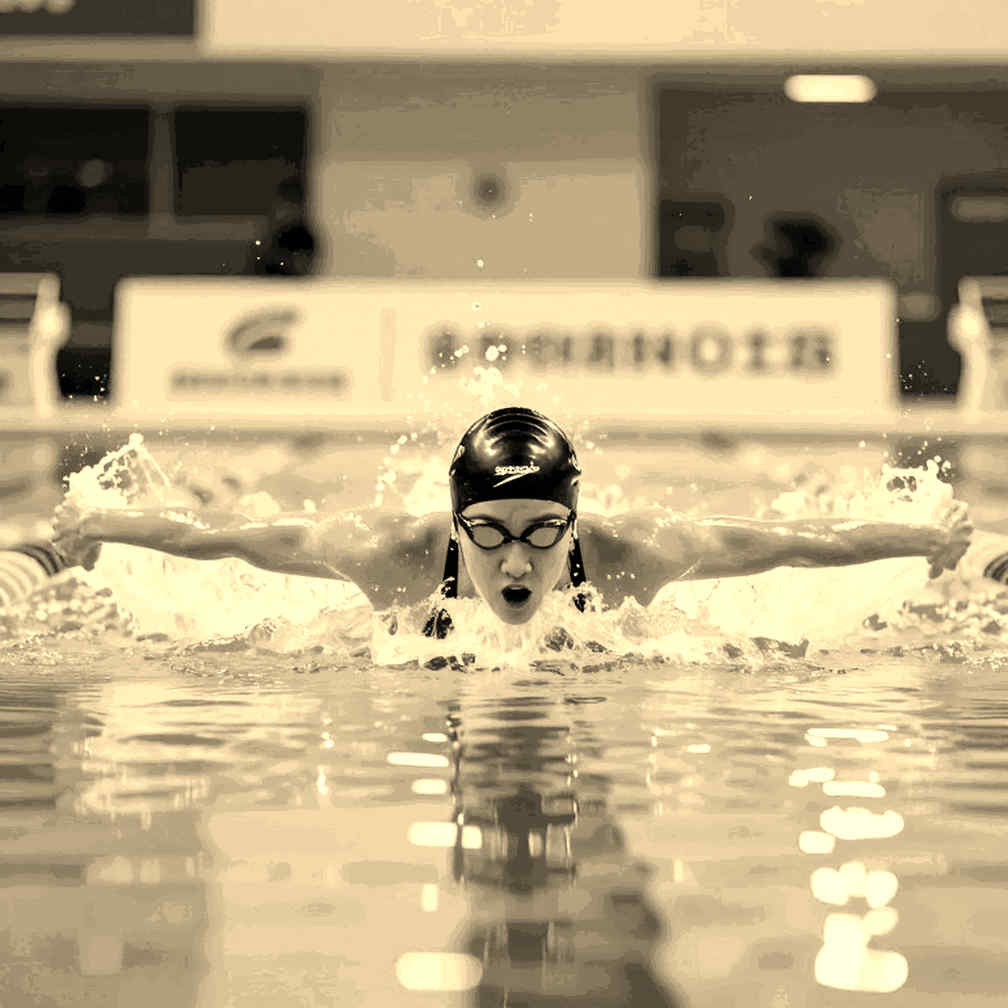
The word technique appears three times in the posting — knowledge of instructing technique, knowledge of proper technique for developmental swimmers, and teaching and maintaining proper technique to the best of the swimmer's ability. The club wants shape before speed. At ten and under, that is the correct call, and the reason is mechanical, not aesthetic. This is the age when scapular control, shoulder-blade stability and core rotation are laid down. Whatever is not laid down here files a damage report on every stroke of the sixty thousand metres a week that comes later. First touch in football is catch and pull in swimming. An academy that teaches tactics before first touch loses later.
One sentence deserves a second look: teaching and maintaining proper technique to the best of the swimmer's ability. The club is conceding that in a group of ten-and-unders, not every stroke will look alike, and it is not promising otherwise. That is realistic, and it also signals something: at this level there is no measurable standard. Time can be measured with a clock; technique cannot, so the responsibility for technique is handed to individual skill. In the foundation layer of swimming instruction, that gap is the largest risk, because bad mechanics accumulate unnoticed over years.
I have watched a stroke error turn into a shoulder ledger at seventeen. At the 2026 World Cup I filed thirty-one injury explainers in thirty-two straight days. Three weeks after that Champions League final tangle, when Mohamed Salah started anyway, I wrote that Salah's shoulder was really a swimmer's shoulder. The labrum and capsule mechanics are identical; only the shirt changes. The piece drew one hundred and eighty thousand reads. The reason is simple: people understand results, but they do not understand movement — and movement happens first.
The loudest thing about the posting is what it leaves out. Across forty-one information points, there is not a single letter for video analysis, underwater cameras, dryland, load monitoring, or injury prevention. Yet the age band described is exactly the age band where injury foundations are poured. Every shoulder has a before and an after; the broadcast tape only shows the after. In Tanvir's case, the before was a few thousand incomplete catches in his teenage years, and the after was a Mirpur final. A club that values technique this much, yet never mentions keeping a long-term health ledger on technique, has affection without infrastructure.
Football commits this error daily — a goalkeeper who can kick long earns an expensive transfer while his basic shot-stopping stays weak for years. Swimming does the same thing in reverse: we watch the clock and ignore the shape. The Rosemead posting is at least walking the other way.
The labour arithmetic is harsher still. Part-time, uncertain hours, mandatory evenings and weekends, two to four years of experience, three professional references, reliable transport between locations. This is the face of the most important coaching job in American swimming. The coach at the bottom of the pyramid teaches a child not to fear water, to plant a foot on the wall, not to hold the breath, not to panic when water enters the ear. That coach earns the least and has the most irregular schedule. The club asks for motivation to compete at their best in training and over the long term. USA Swimming's real crisis is not a shortage of talent — it is swimmers quitting as they age. This position is a retention instrument, and retention instruments are always paid as little as possible.
Governance is where the biggest lesson sits. USA Swimming coaching certifications, Safe Sport training, criminal background checks — these are not topics for discussion, they are compulsory conditions. The job description states separately the ability to recognise and remedy hazardous and dangerous situations, and the ability to recognise students who may need assistance. Those two lines are not coaching skills; they are a protection system. In Bangladesh, no certificate is mandatory to teach a child to swim, and no child-safeguarding training is required. Safety training arrives through voluntary effort — water-safety programmes where instructors are taught hands-on which child to grab first. The difference lies in mandatory systems, not in the quality of individual coaches.
The Rosemead Aquatics Center is an institution-run water body: fixed hours, fixed temperature, fixed depth. Bangladesh's equivalent is the outdoor fifty-metre pool outside Mirpur — closed in the monsoon, cold in winter, and dark once the championship ends. Beyond it lie ponds, canals and rivers like the Ghaghot. Before debating coaching philosophy, that geography has to stay in view, because the same training doctrine does not produce the same result in two different water bodies.
The coach who takes this job faces three real risks. One, time uncertainty — part-time hours shift, evenings and weekends are pre-booked, and the description states plainly that duties can change without notice. Two, an experience shortfall — two to four years may not be enough for work that demands individual attention for ten-and-unders. Three, no information at all about the club's financial health. There is one positive signal, and it is a large one: the posting asks for demonstrated passion for learning, continuing education and improving as a coach, which means the club is willing to invest in its staff.
Now the counter-intuitive turn. A medal table is not the best indicator of a swimming nation's health. The indicator is this question: will a club pay an adult to sit beside a pool on a Tuesday evening so that she can teach an eight-year-old to rotate her hips? As long as the answer is yes, the system is alive. The Rosemead posting is that yes, written on paper. A second counter-intuitive point: a dense club market does not automatically produce champions. Southern California has many clubs and much competition — but that competition is for the same lanes and the same coaches. Rosemead Rapids is not filtering talent here; it is retaining it. The difference is not small: those who fail a filter leave, those inside a retention system stay — and the eight-year-old who is not retained grows up without learning to swim. The third point is my own correction. In 2026 I named the shoulder pain before I examined the movement. Rezaul Karim was right because he looked for the source of pain, not its label. The Rosemead posting stands on the same boundary — it names technique without keeping technique's future account.
So where does the scene stop? I keep filming the pond until the ripple explains the stone. Over recent years I have walked twelve kilometres of the Ghaghot in Rangpur, mapped nine places where children drown, and run remote rehabilitation consults for swimmers training in ponds. By international agency estimates, roughly forty children drown in this country every day. The eight-year-old at the Rosemead Aquatics Center and the eight-year-old at the Ghaghot do not survive the same water, but the question is identical for both: who is sitting beside them? Bangladesh's first big investment is not the hiring of a national coach. It is that part-time coaching post, an adult sitting by the pool in the evening — and before that, the mandatory certificate that defines where teaching a child to swim is safe and where it is not. Of all the frames I have shot, the most honest one is not from a podium. It is an empty chair by the pool, where someone was supposed to be sitting.
Related Players
Recommended
The Twenty-Minute Gap: Zhang Zhanshuo's Dirty Double, a Games Record, and the Long Shadow of 20262026-09-26
Seven Golds in One Night, Two Records Awaiting Ratification, and Mirpur's Unsettled Ledger2026-09-26
The Empty Room in the Ledger: ISHOF Class of 2027, Twelve Names, Eleven Countries, and One Uncounted Absence2026-09-26
The Arithmetic of 52.11: A Record That Lives Only Inside the Yards2026-09-26
Rosemead Rapids Is Hiring a Part-Time Coach for Swimmers 10 and Under: The Unwatched Bottom of the Swimming Pyramid2026-10-01
Two Races in Twenty Minutes: Zhang Zhanshuo's Dirty Double and the Arithmetic of Mirpur's One Pool2026-09-26
Recommended
Twelve Names in Fort Lauderdale, One Empty Lane in Mirpur2026-09-26
The Arithmetic of 52.11: A Record That Lives Only Inside the Yards2026-09-26
A Rosemead Coaching Job Posting That Raises Bangladesh Swimming's Foundation Questions2026-09-30
Seven Golds in One Night, Two Records Awaiting Ratification, and Mirpur's Unsettled Ledger2026-09-26
Skins, Super Skins and Jackpotted Points: The Inaugural College Swimming League Match Rewrote Swimming's Arithmetic2026-09-26
Rosemead Rapids Is Hiring a Part-Time Coach for Swimmers 10 and Under: The Unwatched Bottom of the Swimming Pyramid2026-10-01
Recommended
Twelve Names in Fort Lauderdale, One Empty Lane in Mirpur2026-09-26
The Empty Room in the Ledger: ISHOF Class of 2027, Twelve Names, Eleven Countries, and One Uncounted Absence2026-09-26
Skins, Super Skins and Jackpotted Points: The Inaugural College Swimming League Match Rewrote Swimming's Arithmetic2026-09-26
The Arithmetic of 52.11: A Record That Lives Only Inside the Yards2026-09-26
The Twenty-Minute Gap: Zhang Zhanshuo's Dirty Double, a Games Record, and the Long Shadow of 20262026-09-26
Rosemead Rapids Is Hiring a Part-Time Coach for Swimmers 10 and Under: The Unwatched Bottom of the Swimming Pyramid2026-10-01